


In-Yer-Face Theatre: British Drama Today
Aleks Sierz- Yazar
- Aleks Sierz
- Yayınevi
- Faber & Faber
- Sayfa
- 274
- ISBN
- 9780571200498
Arka kapak
A definitive look at a brash and provocative genre of contemporary British theater.
In the 1990s, British theater audiences were shocked to see blatant portrayals of physical and psychological violence, murder, rape, incest, adultery, drug abuse, and homosexuality onstage. These confrontational and aggressive plays, written by young, honest, and uncompromising playwrights, came to be known as in-yer-face theater. With their use of obscene language, nudity, and even the performance of actual sex acts onstage, the playwrights in this genre intended to force people to think about and question their own desires and impulses. On the flip side, sly humor proved an equal part of the mix when in-yer-face dramatists turned their barbed tongues on the hypocrisy and denial inherent in the decorum of traditional drama.
Mark Ravenhill's Shopping and Fucking, Martin McDonagh's The Beauty Queen of Leenane, and Patrick Marber's Closer are just a few of the plays examined in In-Yer-Face Theatre. Aleks Sierz closely analyzes this new genre in relation to audience and critical reaction as well as to the history and current state of mainstream and fringe British theater. In the process, he provides a vital evaluation demonstrating that in-yer-face is not simply comprised of sensationalist ploys and pessimistic assessments of modern life but in fact offers keen observations on current attitudes toward consumerism,
Alıntılar5
Tümünü gör
Gradually, small groups of enthusiasts learnt the lessons of Zola and Ibsen, Strindberg and Chekhov, Jarry and Tzara, Wedekind and Brecht, Ionesco and Genet, Grotowski and Artaud. Especially Artaud. Not surprisingly, his radical ideas about a Theatre of Cruelty were derived from the Greeks and Jacobeans. One of transgressive theatre’s greatest theorists, he was also the least performed. But his writings proved inspirational:The theatre will never find itself again except by furnishing the spectator with the truthful precipitates of dreams, in which his taste for crime, his erotic obsessions, his savagery, his chimeras, his utopian sense of life and matter, even his cannibalism, pour out on a level not counterfeit and illusory, but interior. (Antonin Artaud, ‘The Theatre of Cruelty: First Manifesto’)This was written during the thirties, and even though Artaud was not immediately translated into English, his ideas rapidly crossed the Channel.

The greatest of the ancient Greek tragedies deal with extreme states of mind: brutal deaths and terrible suicides, agonizing pain and dreadful suffering, human sacrifice and cannibalism, rape and incest, mutilations and humiliations. Thanks to Freud, Oedipus now symbolizes the most familiar taboo — even to people who never go to the theatre. And think of the crimes and emotions, from child murder to incestuous passion, evoked by the names Medea, Phaedra and Agamemnon. The content of tragedy is a meeting between the waywardness of fate and some of our most intimate fears, and the Greeks were well aware of the mixture of heroism and hopelessness involved in taking a stand against the inexorable and inexplicable. But of all the theories about the purpose of tragedy, the most suggestive is the idea that it was meant to purge the bad feelings of the audience. The idea of putting yourself through hell in order to exorcize your inner demons is at the root of experiential theatre. Yet Greek drama was probably intended not to attack but to heal the audience, to make it better able to face its time. This argues for a kind of utilitarian role for theatre, making it a form of shock therapy.
How can theatre be so shocking? The main reason. is that it is live. Taboos are broken not in individual seclusion but out in the open. When youre watching a play, which is mostly in real time with real people acting just a few feet away from you, not only do you find yourself reacting but you also know that others are reacting and are aware of your reaction. Subjects that might be bearable when you read about them in private suddenly seem electrifying when shown in public. Situations that are essentially private, such as sex, seem embarrassingly intimate onstage. Compared with the rather detached feeling of reading a playtext, sitting in the dark surrounded by a body of people while watching an explicit performance can be an overwhelming experience. When taboos are broken in public, the spectators often become complicit witnesses.
Benzer kitaplar
 William Shakespeare
Terry Eagleton
 Hamlet (Ciltli)
William Shakespeare
 Cimri
Moliere
 Godot’yu Beklerken
Samuel Beckett
 Görünmez Tiyatro
Henry Thorau
 Shakespeare: Haset Tiyatrosu
Rene Girard
 Haldun Taner Tiyatrosu
Ayşegül Yüksel
 Kapıların Dışında
Wolfgang Borchert
 Brecht, Lukacs, Bloch Sanat Ve Edebiyat
Onur Bilge Kula
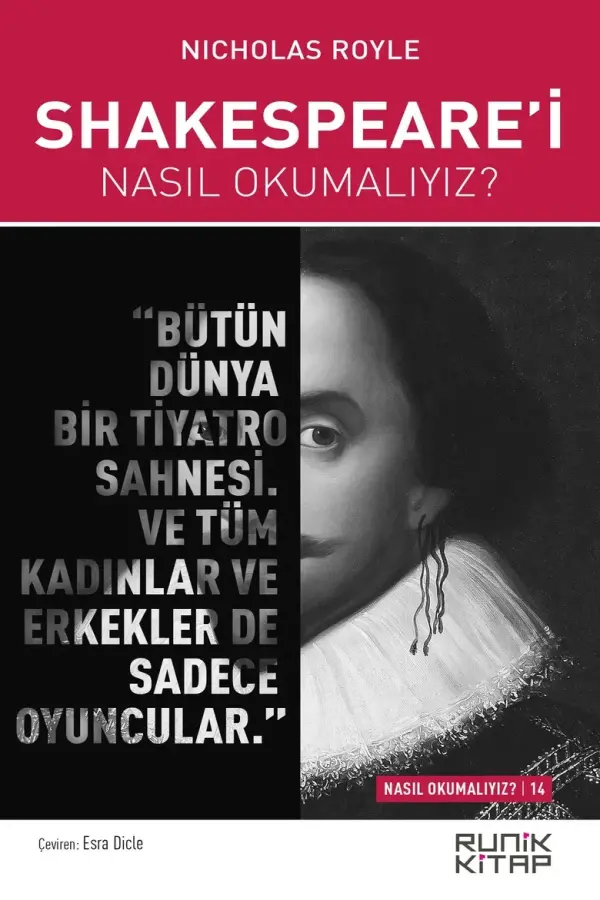 Shakespeare’i Nasıl Okumalıyız?
Nicholas Royle